Chapter 2.1
Increasing Climate Ambition
Position Paper

AUDIO SUMMARY
WHAT ARE THE IMPLICATIONS OF PA ALIGNMENT FOR THE IDB GROUP?
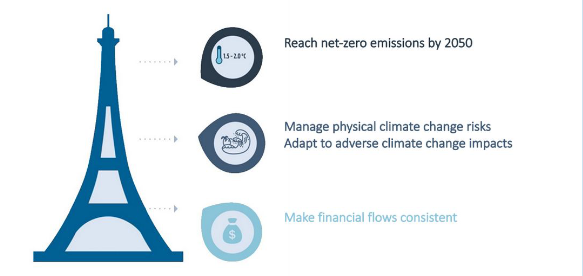
The IDB Group has set a new target to align 100% of new operations with the Paris Agreement (PA) goals by January 2023. This commitment will require our teams to systematically screen all public and private operations and ensure their consistency with net-zero and climate-resilient pathways, based on the MDB Joint Framework to align direct investments with mitigation and adaptation objectives of the Paris Agreement.
-
For mitigation objectives, this means our operations will be consistent with countries’ low-emissions development pathways and avoid costly stranded assets. We will assess our operations against transition risks and opportunities related to low-carbon development.
-
For adaptation objectives, we will be active in managing physical climate change risks, in a manner consistent with climate-resilient development. We will identify opportunities to support a significant increase in our clients’ and their communities’ ability to adapt to the adverse impacts of climate change.
To estimate our current status regarding PA alignment, the IDB Group has carried out an internal analysis of recent and upcoming operation approvals and transactions, both on the public and private sectors. This technical analysis is being used for three main purposes as outlined below.
I. Create a baseline and assess the potential impact of an IDB Group commitment to 100% alignment.
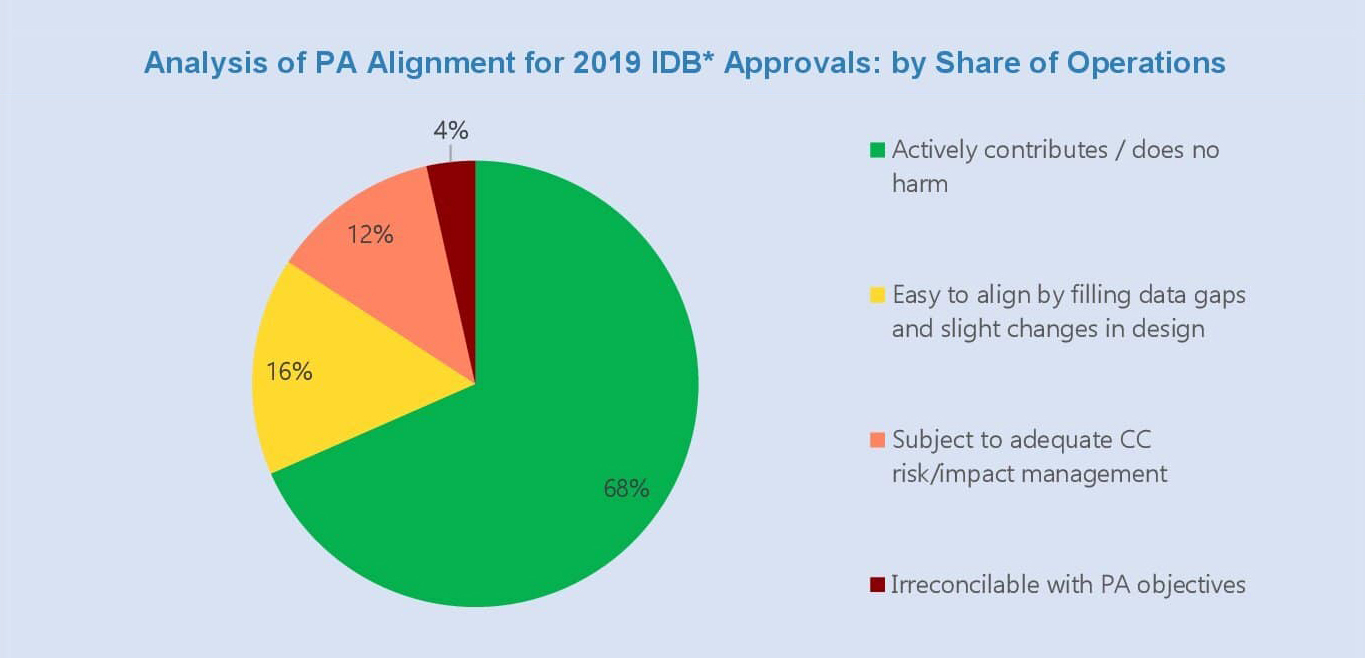
The results of the analysis suggest that ~70 percent of active operations are already aligned, as they build on IDB Group’s ongoing mainstreaming climate change agenda; we estimate an additional ~25 percent could be considered aligned with additional support on design, data, and risk management measures. Finally, we have a 4 to 7 percent share of operations likely not deemed aligned with the PA, and that represents the types of projects that would either need to be essentially reformulated or discarded as potential investments, after a commitment by the IDB Group to be 100% aligned.
II. Understand key challenges in the roadmap to PA alignment
Findings and lessons learned suggest that full alignment will require addressing the following key points:
a. The importance of adopting a programmatic approach to PA Alignment. We learned that while Climate Finance targets help enhance activity-level contributions to mitigation or adaptation, alignment with net-zero and climate-resilience goals requires shifting toward a holistic, long-term vision for transformational decarbonization and resilience across LAC. In practice, this will entail transition from a project-by-project approach; to a more programmatic view of operations, based on facility-scale support that allows countries to align their whole portfolios.
b. The need to strengthen our approach to facilitate a just transition. Ensuring the inclusion of groups most affected by the transition to net zero pathways will help address the political realities of decarbonization. The success of our efforts depends on decarbonizing economies in a socially acceptable way that ensures compatibility with other Sustainable Development Goals (SDGs) and creates economic opportunities for all.
c. Methods to maximize existing resources and access new sources of finance. The PA demands a transformational shift in countries’ development pathways. The IDB will be best equipped to facilitate these changes by making more efficient use of existing resources and enhanced access to concessional finance to address needs that are specific to the PA agenda.
III. Identify critical areas for enhanced models of investment, and develop sector-specific decision criteria
The following are critical sectors where the IDB Group has identified the need to prioritize efforts and investment to ensure full PA alignment:
i. Energy policy and infrastructure, as well as energy-related fiscal management support.
ii. Activities with high propensity to cause indirect land use change and/or that take place in climate-sensitive physical contexts with implications for food security and/or exports (e.g., transportation, agriculture and livestock, urban development, tourism).
iii. Investments that require significant building construction.
iv. Support for GHG-intensive industries (e.g., vehicles, cement, pulp, chemicals).
In response, the IDB Group is in the process of designing internal guidelines that will establish necessary conditions for alignment in these sectors. In addition to the recent U.S. Department of the Treasury Fossil Fuel Energy Guidance for Multilateral Development Banks, our guidelines will incorporate references from: i) the Net Zero by 2050 roadmap developed by the International Energy Agency (IEA), which hails no investment in new fossil fuel supply projects, in order to have a chance of limiting the global temperature rise to 1.5ºC; ii) the position of the Group of Seven on transitioning away from coal-fired power plants and ensuring the decarbonization of electricity supplies; iii) the announcement made by the Government of the United Kingdom to stop providing new direct financial or promotional support for the fossil fuel energy sector overseas. Key issues across all these guidelines include the need to address stranded assets and to transition to cleaner, more reliable, prosperous, and just economies.
Our guidelines will set a precedent for the IDB Group and our region by aiding the development of a PA-aligned pipeline. Furthermore, this will support our efforts to develop a clear communication strategy with our countries to ensure there is full understanding of the need to prioritize climate action.
Preliminary findings of the analysis of PA alignment for 2019 approvals: by share of operations